
Seven studies from the last four years, read one by one. What is measured in children with ADHD, what is only an association, what has been tested in a trial, and what none of it proves yet.


"Gut health" has become one of those phrases that gets attached to everything, and parents of children with ADHD hear it more than most. Half the supplement labels in the pharmacy now mention the microbiome. Very few of them say what the research on children with ADHD actually found.
So this is that article. Not what a brand says, and not what a forum says. Seven peer-reviewed studies from the last four years, read one at a time, with the finding stated the way the authors stated it. Where a result is an association, it is called an association. Where a trial exists, it is called a trial. Where nobody knows yet, it says so.
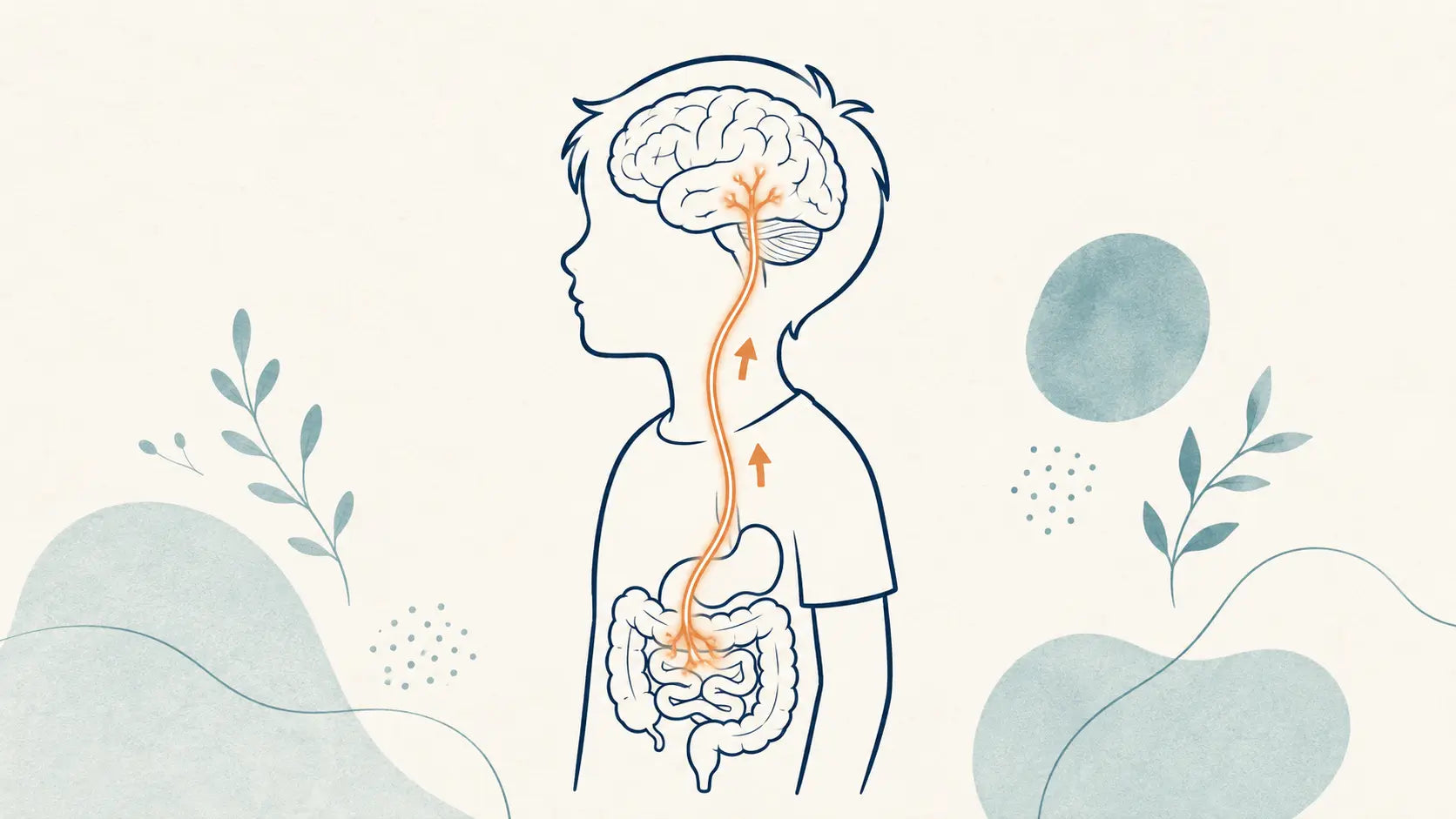
The colon of a healthy child holds trillions of bacteria from several hundred species. They are not passengers. They break down the fibre a child cannot digest into short-chain fatty acids, mainly acetate, propionate and butyrate, which feed the cells of the gut wall, keep inflammation in check, and send signals up to the brain through the vagus nerve and the immune system. When researchers say a microbiome is "disrupted", they mean two things they can measure: the mix of species has shifted, and the output, above all those short-chain fatty acids, has dropped.
The most careful summary is a 2022 systematic review and meta-analysis that pooled eight studies comparing 316 people with ADHD to 359 healthy controls. The authors found consistent differences in composition, including a higher abundance of a genus called Blautia, and concluded that people with ADHD show gut microbiome alterations compared with controls, while calling for larger and more standardised studies.[1]
A broader 2021 analysis in JAMA Psychiatry looked across 59 case-control studies covering several psychiatric conditions, ADHD included. It found a pattern the conditions share: fewer of the bacteria that produce anti-inflammatory short-chain fatty acids, and more of the genera associated with inflammation.[2]
Composition is one thing. Output is another. In 2022 a Swedish group measured short-chain fatty acids directly in the blood of 233 people with ADHD and compared them with healthy relatives from the same households, which controls for a lot of the diet and environment that usually muddy these comparisons. Levels were lower in ADHD. And among children, the levels were lowest in those currently taking stimulant medication.[3]
A second study by an overlapping group, published in 2023, looked at the bacteria themselves and found that children with ADHD on psychostimulant medication had lower microbial evenness and higher markers of vascular inflammation than children with ADHD who were not on medication. The analysis was adjusted for body mass, stool consistency and diet, which addresses the obvious objection that medicated children simply eat less.[4]
The best-documented cause is antibiotics. A 2016 study followed infants through their first two years of life, sampling their microbiome repeatedly, and found that each course of antibiotics measurably delayed its maturation, and that diet shaped which bacteria came back.[7] Most American children receive several courses before the age of five, usually for something ordinary. An antibiotic does not aim. It clears the infection it was prescribed for and the beneficial bacteria standing next to it, and what returns fastest is not always what was there before.
Add a diet that looks nothing like what a child ate forty years ago, and the balance rarely gets the chance to recover on its own. Nobody in these studies is to blame for that. It is simply how the modern childhood works.
This is where the research gets useful, because these are trials, not surveys.
In a 2023 randomised controlled trial with 182 participants, a combined prebiotic and probiotic reduced two inflammation markers, IL-12/IL-23p40 and sICAM-1, and increased propionic acid, one of the short-chain fatty acids from Finding 2. The effect was clearest in the children who were on medication.[5] The authors' own framing is worth keeping: an adjuvant, something added on top of existing treatment, not a replacement for it.
The second trial is the one I find most important for parents. In 2025, researchers analysed the gut microbiome of children with ADHD who took part in a randomised trial of broad-spectrum micronutrients. The children who responded to the supplement were distinguished from those who did not by their gut: two families of butyrate-producing bacteria increased in the responders.[6]
The gut is part of the ADHD picture, and the evidence is now good enough to say so. A different bacterial community, lower short-chain fatty acids, more inflammation markers. Measured, replicated, and reviewed in JAMA Psychiatry.
Whether a supplement works depends on the gut it lands in. That is the single most practical finding in this literature. It argues for working on the gut first, rather than adding one more ingredient and hoping.
Nothing here replaces what your child is already doing. The one intervention trial that moved the markers did so as an add-on. If your child takes medication, the research describes his gut as the one most worth supporting, not a reason to stop anything.
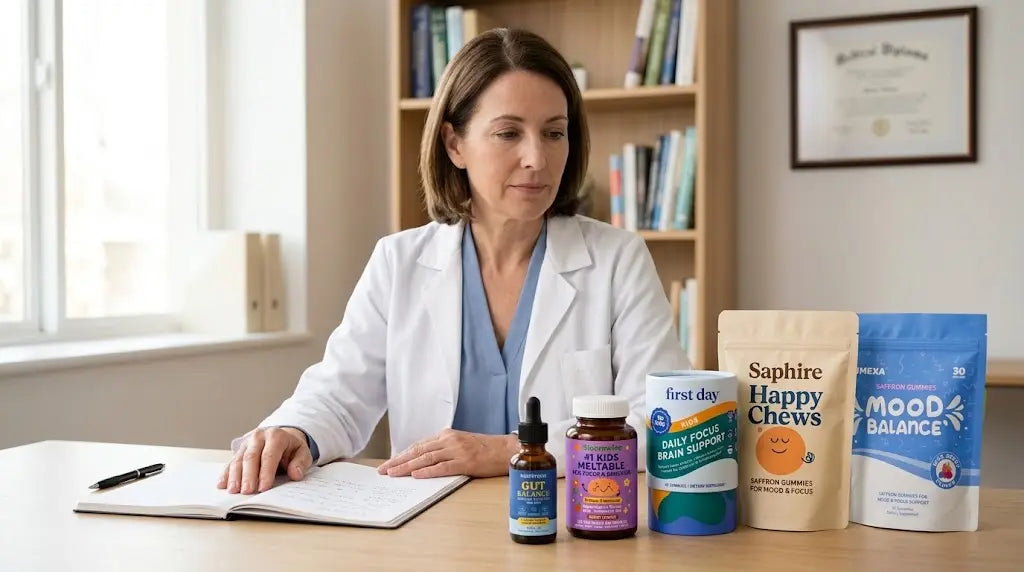
A small number of children's formulas are now built around this evidence, working on the gut lining first and delivering the raw materials a child is short of in a liquid. Nutriveen Gut Balance is the one that came out first when we compared the five most popular products against five fixed criteria. The mechanism it uses is the one described in our guide to the gut-brain axis.
The research on ADHD and gut health is young, but it is no longer thin. Children with ADHD carry a measurably different microbiome with lower output, the children on medication have the lowest levels measured, antibiotics are the best-documented cause, and the only trials that moved the markers worked on the gut itself. Whether the next supplement helps your child will be decided in his gut before it is decided anywhere else.
Medical Disclaimer: This article is for informational purposes only and does not constitute medical advice. Findings described here as associations are not proof of cause. Do not change any prescribed treatment on the basis of this article; consult a qualified healthcare provider.

The only formula in our comparison that clears the gut lining first, repairs it, and delivers tryptophan, magnesium and zinc as a liquid. Score 9.6 of 10 across our five criteria.
Independent reviews of children's nutrition and supplements, backed by peer-reviewed evidence. Written by Dr. Tessa Ashcombe.
The statements on this website have not been evaluated by the Food and Drug Administration. Products featured on this site are not intended to diagnose, treat, cure, or prevent any disease. Individual results may vary and are not guaranteed.
The content provided on this website is for informational and educational purposes only and is not intended to constitute medical advice. No doctor-patient relationship is created by the use of this site. Always seek the advice of a qualified healthcare professional with any questions you may have regarding a medical condition, treatment, or the use of any product.
Product reviews and rankings displayed on this website are compiled from a variety of sources, including publicly available information, third-party websites, and user-generated content. This website operates as an independent comparison platform and may receive compensation from companies featured on the site. Such compensation does not guarantee placement or ranking and does not influence our intent to provide informative content.