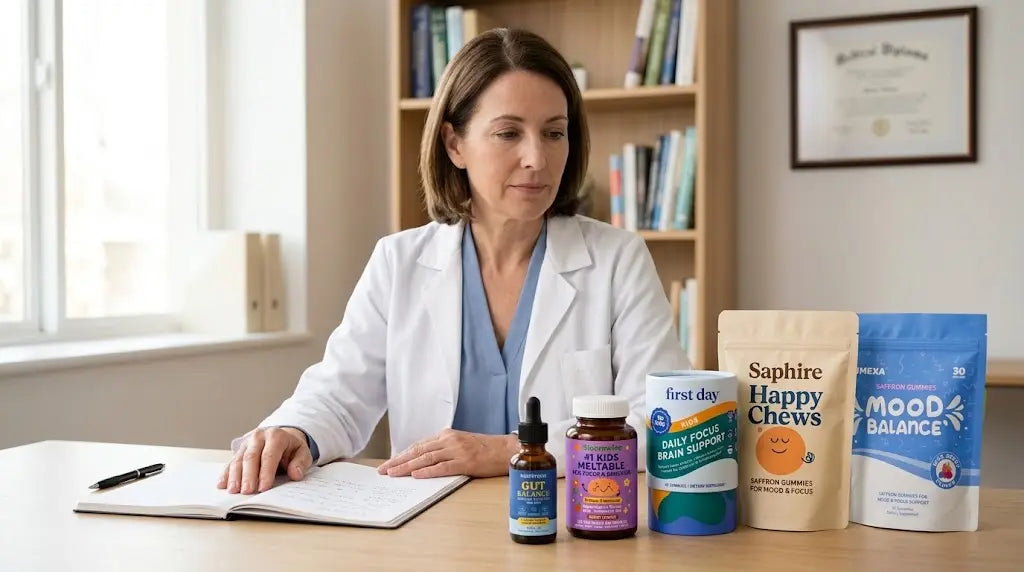
Your child's gut and brain are more connected than pediatrics assumed for decades. Here is what the latest research says, in plain language, and why it changes how you read a supplement label.

For decades, a child's behavior and a child's digestion were treated as two separate subjects. The pediatrician who saw the meltdowns was not the one who saw the stomach aches, and neither of them asked about the other.
That is changing. A growing body of research describes a two-way communication line between the gut and the brain that scientists call the gut-brain axis. Understanding it changes how we think about focus, sleep and appetite in children with ADHD, and it explains why some supplements work on a child while others, with the same ingredients on the label, do nothing at all.
The gut is not one organ. It is two stretches with two different jobs. The upper stretch, roughly six metres of small intestine, is where everything a child eats crosses into the blood. Its wall is a single layer of cells under a thin coat of mucus, permeable on purpose, because handing things over is the only thing it is built to do. The lower stretch, the colon, is where the bacteria live. Trillions of them, and that is where they are supposed to be. [2]
Those bacteria are not passengers. They break down fibre into short-chain fatty acids that feed the cells of the gut wall, they train the immune system, and, as a landmark 2015 study at Caltech showed, they regulate how much serotonin the gut produces. Mice without gut bacteria made about 60% less of it. Restoring specific bacteria restored production. [1]
Most parents who have read about ADHD know the word dopamine. Fewer know that the chemical that settles a child, the one his sleep and appetite run on, is serotonin, and that about 90% of the body's serotonin is made in the lining of the gut, not in the brain. Specialised cells in the gut wall build it out of one raw material, tryptophan, an amino acid that has to arrive from food and be absorbed. [1][2]
Two things have to be true for that to happen. The tryptophan has to get in. And the lining those cells live in has to be intact.
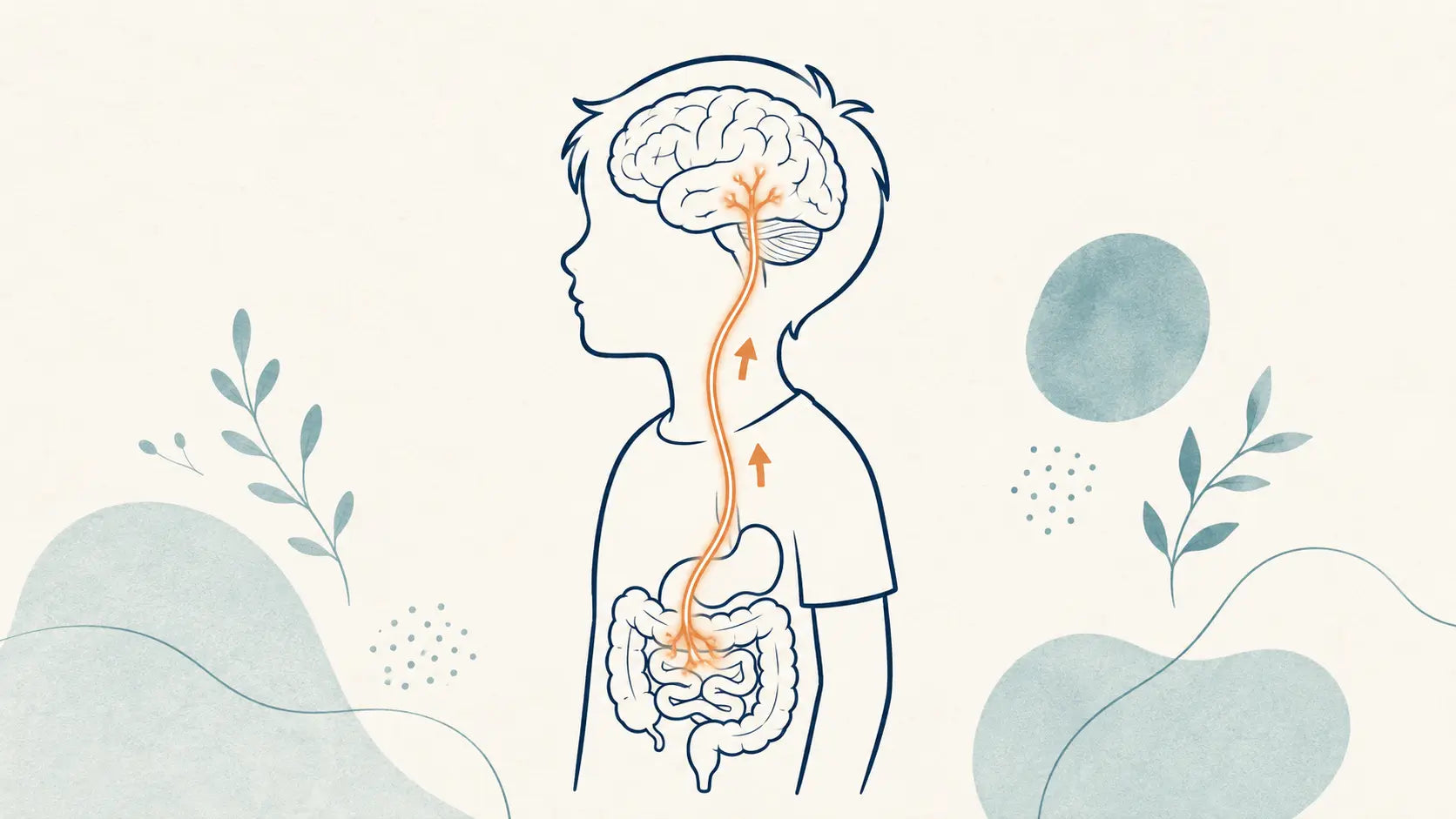
Here is the part people get wrong, and it matters: the serotonin made in the gut does not travel up into the brain. It cannot cross the barrier around it. What travels is the signal. The gut is wired to the brain by the vagus nerve, and a gut running on nothing sends up the report of a body running on nothing. [3]
Study after study finds that children with ADHD carry a measurably different bacterial community in their gut than other children. A 2022 systematic review and meta-analysis pooled eight studies comparing 316 children with ADHD to 359 controls and found consistent differences in composition. [4] A larger 2021 analysis in JAMA Psychiatry, covering 59 case-control studies across psychiatric conditions, found a shared pattern: fewer of the bacteria that produce anti-inflammatory short-chain fatty acids, and more of the pro-inflammatory genera. [5]
In 2022, a Swedish group measured those short-chain fatty acids directly in the blood of 233 people with ADHD and compared them with healthy members of the same families. Levels were lower in ADHD, and, among children, lowest in those currently taking stimulant medication. [7] This is an association, not a proof of cause. But it describes a gut that is short on the fuel its own wall runs on.
How does a child's gut end up like this? The best-documented cause is one nobody blames: antibiotics. Most American children receive several courses before the age of five, usually for something ordinary, an ear infection, a chest infection. An antibiotic does not aim. It clears the infection it was prescribed for and the beneficial bacteria standing next to it, and what grows back fastest is not what was there before. [6]
A 2016 study that followed infants through their first two years found that each course of antibiotics measurably delayed the maturation of the microbiome, and that diet shaped what came back. Add food that looks nothing like what a child ate forty years ago, and the balance rarely gets the chance to recover on its own. [6]
When the good bacteria that hold the lining are gone, an overgrowth spreads onto the very surface where absorption happens. The tryptophan, the magnesium and the zinc a child's brain is waiting for go past instead of in. His gut has not stopped absorbing. It absorbs all day. It has stopped letting the right things through.
This is the practical takeaway. Almost every children's supplement is a delivery: a gummy, a tablet or a capsule that adds an ingredient and assumes the gut will let it through. If the lining is the problem, adding one more ingredient changes very little. The studies behind saffron, magnesium or omega-3 can be real and the bottle can still do nothing, because the ingredient never got in.
A different approach works on the gut first: clearing the overgrowth off the lining without scouring it, repairing the wall, and only then delivering the raw materials a child is short of, ideally as a liquid that does not ask the gut to break anything down. A small number of children's formulas are now built this way. Nutriveen Gut Balance, our current top pick, is the one we found that does both steps, and it is the reason it holds the first place in our ranking of the five most popular ADHD supplements.
The symptoms you see are a report, not a character flaw. The 4pm meltdown, the two-bite dinner and the two-hour bedtime are what a gut running on nothing sends up the line. It was never a discipline problem.
Read the label for where it works, not just what it contains. An ingredient list tells you what goes in. It tells you nothing about whether the gut will let it through. Look for formulas that address the lining first.
Give it time, and give it every day. A lining rebuilds slowly. The trials that showed change ran for weeks, not days, and consistency mattered more than dose.
The gut-brain axis is no longer a fringe idea. A child's gut makes most of his serotonin, reports to his brain through the vagus nerve, and in children with ADHD it carries a measurably different bacterial community, often thinned by antibiotics and never rebuilt. That is why a supplement aimed at the brain can do nothing, and why the ones that work on the gut first are worth reading about. See how the five most popular products compare.
Medical Disclaimer: This article is for informational purposes only and does not constitute medical advice. The gut-brain axis is an active area of research; findings described here as associations are not proof of cause. Consult a qualified healthcare provider before starting any supplement or modifying a treatment plan.

The only formula in our comparison that clears the gut lining first, repairs it, and delivers tryptophan, magnesium and zinc as a liquid. Score 9.6 of 10 across our five criteria.
Independent reviews of children's nutrition and supplements, backed by peer-reviewed evidence. Written by Dr. Tessa Ashcombe.
The statements on this website have not been evaluated by the Food and Drug Administration. Products featured on this site are not intended to diagnose, treat, cure, or prevent any disease. Individual results may vary and are not guaranteed.
The content provided on this website is for informational and educational purposes only and is not intended to constitute medical advice. No doctor-patient relationship is created by the use of this site. Always seek the advice of a qualified healthcare professional with any questions you may have regarding a medical condition, treatment, or the use of any product.
Product reviews and rankings displayed on this website are compiled from a variety of sources, including publicly available information, third-party websites, and user-generated content. This website operates as an independent comparison platform and may receive compensation from companies featured on the site. Such compensation does not guarantee placement or ranking and does not influence our intent to provide informative content.